Demand as a Service B2B: A More Honest Look at Outsourced Pipeline in 2026
B2B teams are under pressure to deliver predictable pipeline without inflating budgets or overpromising results. Demand as a Service B2B is gaining traction as a response, but behind the positioning lies a more complex reality. This article examines where outsourced demand generation genuinely delivers value, where it breaks down, and how to evaluate it without falling into the same traps that have undermined traditional demand programs.
The Rise of Demand as a Service B2B and Why It Is Not Just Rebranded Outsourcing
The idea of outsourcing pipeline creation is not new. What has changed is the expectation around outcomes. Traditional outsourced demand generation focused on activity volume. Today, Demand as a Service B2B is positioned around accountability for pipeline quality, conversion, and revenue alignment.
Recent trade reports and industry commentary highlight a shift in how marketing leaders evaluate external partners. It is no longer about lead volume or campaign execution alone. The expectation is that managed demand generation services contribute directly to pipeline creation that sales teams trust. This change is being driven by three structural realities.
First, buying cycles are longer and more complex. Multiple stakeholders are involved, often including Chief Procurement Officers (CPOs), finance leaders, and operations teams. A single campaign rarely influences a decision. This increases the difficulty of building consistent pipeline internally.
Second, internal teams are stretched across channels and platforms. Running paid media, content, intent data, and sales enablement as a coordinated system requires both scale and specialization. Many organizations lack the operational depth to execute consistently.
Third, attribution remains imperfect. Even with advanced analytics, connecting early engagement to revenue is still probabilistic. This creates pressure to demonstrate value through pipeline movement rather than top of funnel metrics.
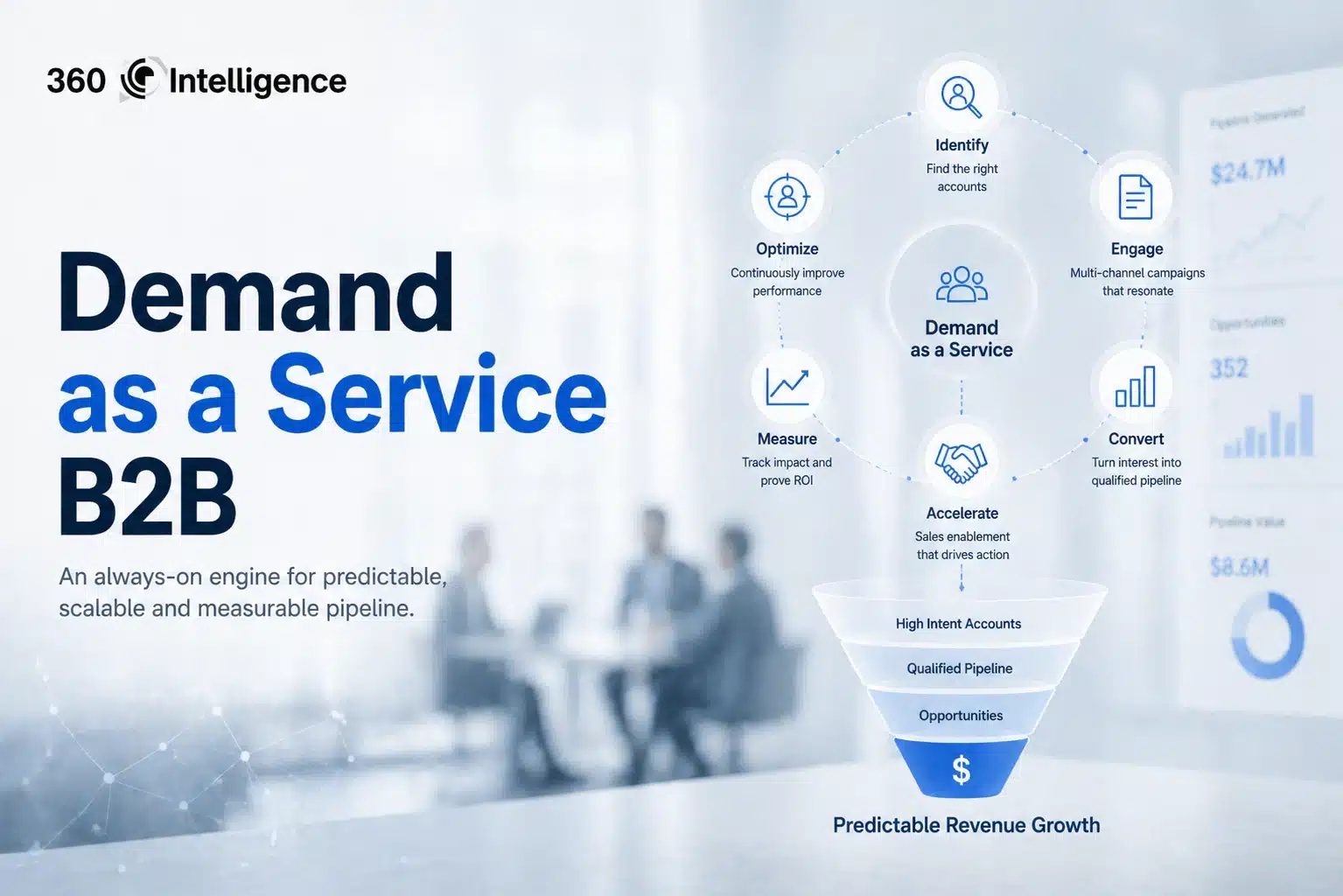
Demand as a Service B2B attempts to address these issues by offering a structured, ongoing pipeline engine rather than a series of campaigns. But the distinction between promise and delivery depends heavily on how these services are structured and governed.
Where Outsourced Demand Generation Actually Works and Where It Does Not
The strongest argument for outsourced demand generation is consistency. When executed well, it creates a repeatable system that combines targeting, messaging, and sales follow up into a single workflow. However, this only works under specific conditions.
When It Works
Outsourced demand generation performs best when there is already clarity on positioning and audience. If a company understands its core value proposition and has defined its ideal customer profile, external teams can amplify what already works.
It is particularly effective in three scenarios:
- Scaling proven messaging
If campaigns have already shown traction, outsourcing allows teams to scale without overloading internal resources. External teams can operationalize distribution, testing, and optimization at a faster pace. - Expanding into new segments with defined hypotheses
Managed demand generation services can accelerate entry into adjacent markets when there is a clear hypothesis about buyer pain points and outcomes. - Supporting sales in multi stakeholder deals
In complex deals involving CPOs and cross functional stakeholders, external teams can build coordinated nurture streams that support internal alignment across the buying group.
In these cases, the value comes from execution discipline rather than strategic reinvention.
Where It Breaks Down
The most common failure point is using outsourced demand generation as a substitute for strategy. If positioning is unclear, external teams will default to generic messaging. This leads to campaigns that generate engagement but fail to convert into meaningful pipeline.
Another challenge is misaligned incentives. Many providers still optimize for leads or meetings rather than qualified opportunities. This creates friction with sales teams, who often distrust externally generated pipeline.
There is also a structural limitation around attribution. External providers typically operate outside the full customer journey. This makes it difficult to measure their true impact, especially in long sales cycles where multiple touchpoints influence decisions.
Finally, there is a dependency risk. Over reliance on external teams can limit internal capability development. When organizations lose visibility into how pipeline is generated, they also lose the ability to adapt quickly.
Managed Demand Generation Services vs In House Teams: The Real Trade Offs
The decision to invest in managed demand generation services versus building internally is not simply a cost comparison. It is a trade off between control, speed, and long term capability.
Control vs Speed
In house teams offer greater control over messaging, brand, and customer experience. This is particularly important in complex markets where differentiation is subtle and credibility is built over time. External teams offer speed. They can deploy campaigns quickly, test multiple channels, and iterate faster than most internal teams.
The trade off is that speed often comes at the cost of depth. External teams may not fully understand the nuances of the product or market, which can limit effectiveness in high consideration purchases.
Cost Structure and Budget Thresholds
Outsourced demand generation is often perceived as a flexible cost model. In reality, it requires a meaningful investment to deliver results. Below a certain threshold, typically where budgets are fragmented across multiple channels, outsourcing can dilute impact. Effective Demand as a Service B2B requires concentrated investment in targeting, content, and distribution.
Internal teams, while more resource intensive upfront, can deliver better returns over time if they build scalable processes and institutional knowledge.
Attribution and Measurement
One of the most overlooked trade offs is measurement. Internal teams have full visibility across the funnel, allowing for more accurate attribution. External teams often rely on partial data, which can lead to over or under estimation of their impact.
This becomes particularly important when evaluating ROI. Without clear attribution, it is difficult to determine whether outsourced efforts are driving incremental pipeline or simply capturing existing demand.
B2B Pipeline Outsourcing 2026: What Has Actually Changed
The conversation around B2B pipeline outsourcing 2026 is often framed as a shift toward more advanced technology and data driven decision making. While this is true, the more important change is how buyers engage with vendors.
Buyers now conduct extensive research before engaging with sales. According to recent data, a significant portion of the buying journey is completed independently. This reduces the effectiveness of traditional outbound tactics and increases the importance of high quality, relevant content.
As a result, successful outsourced demand generation programs are evolving in three key ways:
- Integration of intent signals with content strategy
Rather than simply targeting based on firmographics, advanced programs use intent data toidentify active buying signals. However, intent data alone is not enough. It must be combined with content that addresses specific buyer concerns. - Alignment with sales processes
Pipeline outsourcing is no longer isolated from sales. Effective programs integrate with sales workflows, ensuring that leads are followed up quickly and appropriately. - Focus on pipeline progression, not just creation
The emphasis is shifting from generating leads to moving opportunities through the funnel. This requires coordinated efforts across marketing and sales, as well as a deeper understanding of buyer decision processes.
Despite these advancements, the fundamentals remain the same. Clear positioning, relevant messaging, and consistent execution are still the primary drivers of success.
Evaluating Demand as a Service B2B: Questions That Actually Matter
For organizations considering outsourced demand generation, the key is to move beyond surface level evaluation criteria. Instead of focusing on capabilities or channel expertise, the evaluation should center on how the provider approaches pipeline creation. Here are the questions that tend to reveal the most:
- How do you define qualified pipeline?
If the definition is based on leads or meetings, there is likely a misalignment with sales expectations. - What is your approach to messaging development?
Providers should be able to demonstrate how they translate product capabilities into buyer relevant outcomes. - How do you handle attribution across long sales cycles?
A credible answer will acknowledge limitations and explain how they measure contribution rather than claiming precise attribution. - What level of integration do you require with internal teams?
Effective programs require close collaboration. If the model is overly hands off, it may indicate a lack of depth. - What happens when campaigns underperform?
The ability to diagnose and adapt is critical. Providers should have a clear process for identifying issues and implementing changes.
These questions help shift the focus from tactical execution to strategic alignment, which is where most outsourced programs succeed or fail.
Why Demand as a Service Is Not a Shortcut to Pipeline Growth
One of the most common misconceptions is that Demand as a Service B2B provides a faster path to pipeline growth. In reality, it introduces a different set of constraints. External teams can accelerate execution, but they cannot replace the need for clear strategy and internal alignment. Without these foundations, even the most sophisticated programs will struggle to deliver results.
There is also a tendency to overestimate the impact of external efforts. Pipeline growth is influenced by multiple factors, including product market fit, competitive positioning, and sales effectiveness. Outsourced demand generation is only one component of this system. Organizations that treat it as a standalone solution often experience diminishing returns over time.
The Real Opportunity Is Not Outsourcing. It Is System Design
The most effective use of outsourced demand generation is not as a replacement for internal capability, but as part of a broader system. This means defining clear roles for internal and external teams, aligning incentives, and establishing shared metrics for success. It also requires a shift in mindset. Instead of asking how to generate more leads, the focus should be on how to create a system that consistently produces and converts demand.
Recent industry insights suggest that organizations that take this approach are more likely to achieve sustainable pipeline growth. They use external partners to enhance execution while retaining strategic control internally. This balance allows them to scale without losing visibility or flexibility.
A Final Thought: Pipeline Is Built Through Alignment, Not Outsourcing
The appeal of Demand as a Service B2B is understandable. It offers a way to address immediate pipeline gaps without expanding internal teams. But the long term advantage does not come from outsourcing itself. It comes from how well organizations align strategy, execution, and measurement across the entire revenue process.
Outsourced demand generation can play a valuable role in this system. However, its effectiveness ultimately depends on the strength of the foundation it is built on. The organizations that succeed are not those that outsource the most. They are the ones that understand where external support adds value and where it does not, and design their pipeline strategy accordingly.