
Cold, Warm, and Sales Reset Leads: Why B2B Lead Classification Needs a Rethink
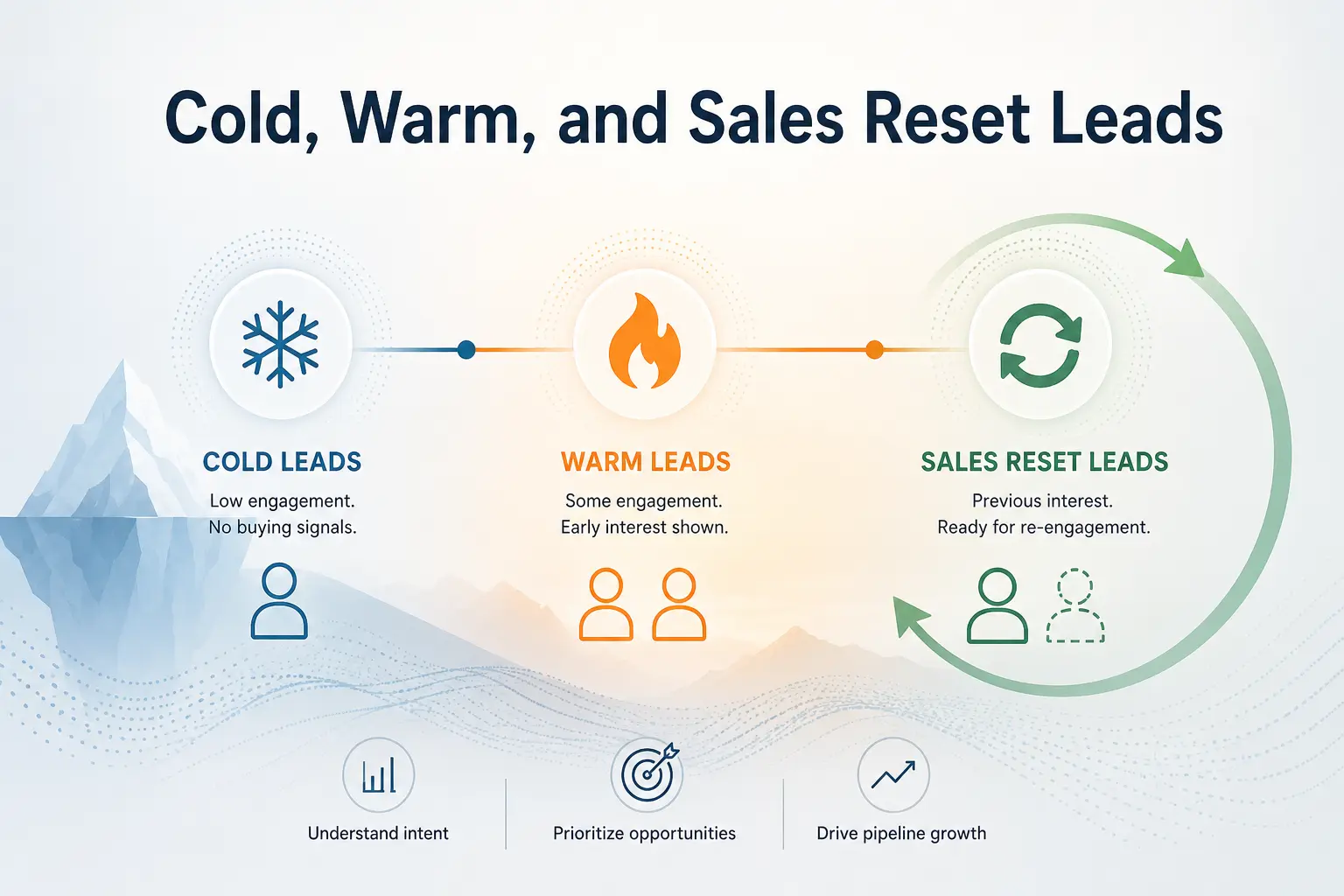
Most B2B demand teams still classify leads using outdated rules that fail to reflect modern buying behavior. A contact who downloaded a report six months ago may suddenly become highly relevant because of a funding event, a technology migration, or a leadership change. Meanwhile, highly engaged prospects can remain inactive for months despite multiple signals. The challenge is no longer simply identifying cold and warm leads. It is understanding when buying conditions change and when a lead deserves a sales reset.
Marketing and sales teams have invested heavily in lead scoring, intent platforms, and automation. Yet many organizations still struggle with pipeline efficiency because lead classification models are built around activity rather than buying readiness.
This creates a critical question: how should modern B2B teams define cold leads, understand warm leads meaningfully, and apply sales reset classification criteria to opportunities that previously stalled?
The answer has become increasingly important in long sales cycle environments where multiple stakeholders influence decisions and buying intent develops gradually.
Executive Summary
- Traditional lead scoring often fails in complex B2B environments.
- Cold lead definition has evolved beyond simple inactivity.
- Warm leads meaning depends on context, buying signals, and organizational change.
- B2B sales reset classification criteria help revive previously stalled opportunities.
- Teams that distinguish between dormant and genuinely lost prospects often improve pipeline efficiency.
- Effective lead classification combines intent signals, account context, and commercial timing.
Why Traditional Lead Stages No Longer Work?
Many organizations continue using three basic stages:
- Cold lead
- Warm lead
- Sales qualified lead
The simplicity appears attractive, but modern B2B buying behavior rarely follows this linear model.
Research from multiple buying studies consistently shows that enterprise purchases involve numerous stakeholders, extended evaluation periods, and long periods of inactivity between buying activities.
A prospect may:
- Attend a webinar.
- Download several reports.
- Engage with content.
- Go silent for six months.
- Reappear because of a budget cycle.
Traditional lead models often classify such contacts as dead opportunities when they may simply be waiting for internal conditions to change. This creates two major problems:
- Sales teams waste time pursuing leads that are not ready.
- Marketing teams stop nurturing accounts that later become active buyers.
The result is reduced conversion efficiency and unnecessary pipeline leakage.
What is a Cold Lead?
The cold lead definition is often oversimplified. Many organizations define cold leads as prospects who:
- Have never engaged.
- Have not responded to outreach.
- Have shown no recent activity.
While these indicators remain relevant, they do not provide sufficient context. A cold lead is better defined as “A contact or account showing limited evidence of active buying intent, organizational readiness, or commercial urgency”.
This distinction matters. A prospect may have opened emails and downloaded assets yet still be cold because:
- No budget exists.
- No internal sponsor exists.
- No business problem has been identified.
- No project timeline exists.
Conversely, a previously inactive account may suddenly become highly relevant because of external events. Examples include:
- Technology migrations.
- Regulatory changes.
- New leadership appointments.
- Mergers or acquisitions.
- Supply chain disruptions.
- Procurement transformation programs.
This means inactivity alone should not determine whether a lead is cold.
Common Characteristics of Cold Leads
Cold leads often display several indicators:
- Low engagement frequency.
- No recent website activity.
- Generic content consumption.
- No stakeholder expansion.
- Lack of business urgency.
- Absence of buying signals.
- Minimal interaction with commercial content.
However, these characteristics should be evaluated at both contact and account levels. An individual contact may appear inactive while the wider organization demonstrates growing interest.
Understanding Warm Leads Meaning in Modern B2B
Warm leads meaning has also evolved significantly. Traditionally, a warm lead was simply someone who:
- Opened emails.
- Downloaded content.
- Visited the website.
- Registered for webinars.
These actions still matter, but senior marketing teams increasingly focus on the quality of engagement rather than activity volume. A genuinely warm lead often demonstrates:
- Problem awareness.
- Solution exploration.
- Stakeholder involvement.
- Budget discussions.
- Vendor evaluation.
- Internal alignment activity.
In practical terms, a warm lead is a prospect that has demonstrated both engagement and potential buying intent. This distinction prevents marketing teams from passing large numbers of unqualified leads to sales.
The Difference Between Engagement and Intent
One of the biggest mistakes in lead classification is assuming engagement equals purchase intent. A prospect can:
- Read five articles.
- Attend an event.
- Download multiple reports.
Yet still have no active project. Meanwhile, another account may visit pricing pages only twice before entering an active buying process.
Intent often appears through combinations of signals:
- Category research.
- Competitor comparisons.
- Solution evaluation content.
- Stakeholder expansion.
- Budget discussions.
- Procurement involvement.
Effective classification requires these signals to be interpreted together rather than individually.
The Rise of Sales Reset Classification Criteria
One of the most important developments in B2B demand generation is the concept of sales reset classification criteria. Many opportunities enter CRM systems, stall, and eventually become inactive.
Historically these opportunities were categorized as:
- Lost.
- Closed.
- Disqualified.
However, many stalled opportunities eventually return. A sales reset recognizes that buying conditions can change. Examples include:
- New leadership appointments.
- Budget approval.
- Operational disruptions.
- New strategic priorities.
- Technology replacement cycles.
Instead of treating these accounts as permanently lost, organizations increasingly create reset stages.
Key B2B Sales Reset Classification Criteria
Several criteria commonly trigger sales reactivation.
- Organizational Change
New executives frequently reassess existing priorities. Leadership changes can reopen previously stalled initiatives.
- Increased Intent Activity
Renewed research activity often indicates changing needs. This may include:
- Website visits.
- Content consumption.
- Competitive research.
- New Stakeholder Involvement
Additional stakeholders often signal buying committee formation. This is especially important in complex B2B purchases.
- Budget Cycle Changes
Many opportunities stall simply because funding was unavailable. New financial periods can change purchasing decisions.
- External Market Pressure
Regulatory changes, operational risks, or competitive threats can create urgency. These factors often restart buying processes.
Warm Leads vs Cold Leads Conversion Rate Multiplier
Many organizations ask whether warm leads significantly outperform cold leads. The answer is generally yes, but the gap is often misunderstood. The warm leads vs cold leads conversion rate multiplier depends on several factors:
- Industry.
- Sales cycle length.
- Deal complexity.
- Market maturity.
- Lead source.
In practice, warm leads consistently convert at higher rates because:
- Problem awareness already exists.
- Stakeholders are engaged.
- Internal discussions have begun.
- Commercial timing is closer.
However, organizations sometimes overinvest in warm leads while ignoring future demand creation. This creates pipeline volatility. The strongest teams maintain balanced investments across:
- New demand generation.
- Lead nurturing.
- Existing pipeline.
- Reactivation programs.
Why Cold Leads Should Not Be Ignored
Cold leads frequently become future opportunities. Several studies across B2B markets suggest that many buyers are not ready to purchase during their initial interaction.
This creates an important challenge. Sales teams prioritize immediate opportunities. Marketing teams focus on nurturing. Without coordination, cold leads disappear from visibility.
Effective programs maintain engagement through:
- Educational content.
- Industry insights.
- Benchmark reports.
- Event invitations.
- Executive research.
- Problem diagnosis tools.
These activities preserve relationships until buying conditions change.
Building a More Practical Lead Classification Framework
A modern framework often includes five categories.
|
Stage |
Definition | Primary Action |
|
Cold Lead |
Limited intent or urgency |
Nurture |
|
Engaged Lead |
Active content consumption |
Educate |
|
Warm Lead |
Demonstrated buying interest |
Qualify |
|
Active Opportunity |
Commercial evaluation underway |
Sales engagement |
| Reset Opportunity | Previously stalled account showing renewed signals |
Re-engage |
This approach reflects actual buying behavior more accurately. It also improves alignment between marketing and sales.
Questions Marketing Leaders Should Ask
Before redesigning lead classifications, several questions matter.
- Are we measuring activity or intent?
- Are we evaluating contacts or accounts?
- How long do opportunities actually take to close?
- What causes deals to stall?
- Which signals predict future purchases?
- How often do lost opportunities return?
The answers frequently reveal that existing classifications are overly simplistic.
Frequently Asked Questions
- What is a cold lead?
A cold lead is a prospect or account that shows limited evidence of active buying intent, commercial urgency, or project readiness.
- What does warm leads meaning refer to?
Warm leads are prospects demonstrating meaningful engagement and signs of potential purchase intent.
- What are B2B sales reset classification criteria?
Sales reset classification criteria identify previously inactive opportunities that deserve renewed sales attention because of changed circumstances or new buying signals.
- Do warm leads convert better than cold leads?
Yes. Warm leads generally convert at significantly higher rates because they have already demonstrated interest, urgency, or buying activity.
- Should cold leads remain in marketing programs?
Yes. Many cold leads eventually become active buyers as priorities, budgets, and business conditions change.
The Real Competitive Advantage Is Timing
Most lead classification systems focus on the present. The strongest organizations focus on change.
A cold lead today may become tomorrow’s priority account. A stalled opportunity may become the largest deal in the pipeline after a leadership change. A warm lead may remain inactive for months before a budget cycle creates urgency.
The future of lead management is not simply distinguishing between cold and warm leads. It is recognizing how buying conditions evolve over time.
Organizations that build sales reset models, monitor account signals, and understand commercial timing gain a significant advantage over teams that rely solely on static lead scores.
Pipeline performance increasingly depends not on finding more leads, but on recognizing when existing leads become relevant again.